Saturday, 12 July 2014

Into the Past

            Intanbul was barely awake when we were introduced to the smooth little machine that constitutes the “Crowded House” tours. Since we were amongst the first to be picked up we had a city tour thrown in for free. The bus driver looped his way skilfully by the many small winding streets, stopping at small inns and hotels crowded around the Hagia Sofia to give Mr Greenpants the time to go and look for guests booked on the tour. At one point, the driver started up the bus and I was sure he had given up on Mr Greenpants who just wasn’t coming down the street with yet more guests. But we merely looped around an elaborate set of streets that involved going in the wrong direction on a one-way street only to bring us back to where we started.
            Still, no Mr Greenpants in sight.
            Just as I was starting to wonder if he would ever appear again, he came triumphantly tramping down the road, another couple from “down under” in tow. This excursion is a great favourite with Aussies and Kiwis, as the tour operators so affectionately call the visitors who come all the way from the end of the globe to visit a place where their ancestors fell, a century ago, next year.
           As we were threading our way through the city, soon yellow taxis joined us in this quest to get people to places they want to go. Then more and more pedestrians joined the fray and, by 7am we picked up the last couple. They were from New Zealand and looked rather chipper for a couple well past their middle years, who had just flown thirty-four hours to enjoy a three day stay in Istanbul that simply had to include a get-away to Gallipoli.
            When you leave Istanbul, by whichever means, you can’t help but marvel at how far and wide the city spreads. It took the better part of an hour before we left the greater Istanbul area and it took a whole lot longer before buildings started to give away to fields and fields to marshy areas where rice is cultivated. But before we came to the fields of sunflowers with round faces seeking the sun, we made a pitstop at a large roadside place that, very likely, caters mainly to the countless buses ferrying Aussies, Kiwis, and the odd Canaducks, to Gallipoli.
            There we were given a breakfast that was less fancy than it was satisfying but that certainly did the trick. Meanwhile, our bus was also pampered, not just with a full gas tank but by a man wielding a yellow brush that first spouted soap and then water. By the time we left, we were all feeling a whole lot more ready for what lay ahead.
       
After we drove close by the border with Greece, or Yunanistan as the Turks and Persians call it, Th and I soon admired the beautiful stretch of blue water that appeared to the north of us. Not an eager map reader, I had no clue where I was so I didn’t know we had entered the peninsula. Stubborn by nature, I almost got in a fight with my husband about the location of the North Pole. Unbeknownst to me, it was the Aegean, which is why it was where it was. 
           The Aegean will do that to a person. When Odysseus sailed away from Troy, he strayed from the sea into the clouds and it took him years to get home. It is a place that entangles and it will come between a husband and wife.
           
In Eceabat, we stopped at the “Crowded House” headquarters, a hotel and restaurant right by the ferry and across from a giant statue showing soldiers at war. We were told to put our luggage in a room behind the desk and were then ushered to another plain but satisfying meal. All part of this excellent tour package. Those of us who were going on the ferry to make the crossing to Çennakale, were handed from Mr Greenpants to Zuzu, a comely lass with half her head shaven, a thick braid on top of her head fashioned from the abundance of left-over hair, a mouth shaped like a smiling crescent and round cheeks with high cheekbones in a perfectly shaped oval head.
            A natural beauty, and fun.
            She showed none of the nervousness of Mr Greenpants as she ushered us through the gates of the ferry. She even paid the fare for us. We had nothing to do but to follow her directions. A regular mother hen shepherding her charges, she bid us welcome once we landed on the Asian side and then she herded us into a large van, with seats that were a relief after the hard-back chairs in the other bus that had me twist my legs in impossible configurations just to take the load off my back a bit.
            The Dardanelles looked even more enchanting from here than they did from the other side. Our company in the bus was small and different from the trip into Eceabat. We didn't know one another but Zuzu took care of that. There was a driver with handsomely greying hair that she introduced as one of the best and there was a set of three rather adventurous men. They all were somewhere in their low forties and clearly determined to live life outside the main track. One a teacher from Ireland, away from it all. Another one, Pieter. A Dutchman who didn’t want to get trapped in an ordinary life so he dedicated himself to being a personal guide to travellers. It makes him enough of a living but it keeps him happy and moving. Free.
            And then there was Joe, an Australian man, who eventually told us his recently deceased father wanted him to do just this. Get away, travel on the cheap, and make a movie about it. Zuzu took special care of him as he wasn’t part of the usual package. This included, dropping him off at the local campsite on our way to the Troy site.
            His smile was easy, his eyes looked as far away as the country he came from. We left him to set up his tent.
           
Meanwhile, we went on to the site and learned all about Troy I, II, III, IV, V, VI, VII, and possibly VIII.  Zuzu was a diligent and entertaining teacher. She kept the tramp through the old ruins fun while she told us the many legends and tales, not just of those who lived and suffered here but also of those who came here later to unearth history. Such tales are invariably connected to ancient sites and add to their mystery.
            Meet Heinrich Schlieman, the nineteenth-century German business man with a love of the Iliad. Near the end of his century, he went and dug at what he believed was the site of Homer’s Troy. Since he went to work before archeology was a profession, he wasn’t always as diligent as we now expect archeologists to be when approaching possible sites. He dug too fast and too deep and so destroyed a lot of the actual site of the Fall of Troy. The battle depicted in the movie Troy. The horse of this movie was donated to Çanakale and graces its waterfront. If I guessed right, Zuzu was happy the horse was the only thing the movie producers donated to the region. She was none too happy with Hollywood's choice of stars.
            But never mind that, let’s just hear what she had to say about how Schlieman circulated the rumour that he found Priam’s treasure, including a stash of Helen’s jewels. He dismissed his team for the day and later said that he and his gorgeous young Athenean wife had done this in order to steal the treasure. It is not at all clear that this really came to pass because he, himself, eventually admitted he circulated the rumour in order to heighten interest in the site. There is, however, a picture of his wife draped in Helen’s jewels on Wikepedia, and the alleged treasure is now on display at the Pushkin Museum in Moscow.
            Zuzu likes to believe the treasure is still buried somewhere at her site.
           
Robberies at digs are not uncommon, she told us. Then she went on to show some of the care present day archeologists take covering up the sites they unearth, storing the artifacts they find in secure places.
            After our two-hour tour of the site, we stopped at the campsite again where we could order coffee, tea, ice-cream, and buy souvenirs to our hearts’ content. Joe was already sitting at a table. We went and sat at the table next to his. 
Settled at the campsite now, he told us about his father and then we learned that his film equipment had broken down. He had now decided to write about his trip and the open notebook in front of him certainly added evidence as to his intent.
            He looked past us with windswept eyes and I got the distinct feeling he was planning to stay on for quite a while. When I asked Zuzu the next day, if she would see Joe again, she said: “I sure hope so.”
           
On the Dardenelles, or Hellespont, as it was known, tales of love and passion flourish. It is here that Leander swam across to the European side every night to find his love Hero, who lit a lamp to guide him. One night the lamp was blown out by a fierce wind, Leander drowned, and Hero threw herself from her tower. It is here too that Lord Byron swam the course in honour of Leander and Hero. And it is here that, yearly, Lord Byron swims are organized.
            That night, sitting at a seaside restaurant, we saw a few dolphins swim by in pairs. Large triangle, small triangle, side by side. The next morning the water was full of dolphins again but by the time we crossed, the water was still as if in honour of the guided tour we were about to embark upon.
           
Gallipoli saw its share of blood during World War I. Allied blood and Turkish blood. We crossed from the Dardanelles to the Agean and back again, with a bus full of Australians and New-Zealanders. This peninsula is preserved as an enormous monument to what occurred there in 1915, when the hills were depleted of trees and people were fighting hand to hand.
            It was hard to picture the dying and rotting corpses of the soldiers who had fallen in between the lines of defence. It came as a relief to hear from our very knowledgeable guide how, at times, fighting would be halted so that enemy sides could help one another out. Once they did so to bury their dead. At times they would throw food at one another over enemy lines with Ottoman soldiers throwing back the cans of spam the other side sent them.
            On this side of the Dardanelles reality and legend are not any clearer than they are on the other side. There is the story of Simpson and his donkey, who dragged many wounded fellow soldiers to safety before he finally fell. And there is the statue of a Turkish soldier carrying the body of an enemy soldier to safety. 
           
War is a waste. That much was clear. And such tales of heroism help us stomach it.
        A young man in our company had dragged his mother and sister all the way form Australia because he wanted to find the grave of his great-grandfather. He did and, from then on, at every site, he stood looking into the past, his eyes thoughtful and his ears open for every thing the guide told us. And this guide did not stop talking from the moment we left until we got back three hours later.
            The tour ended with a visit to the epic statue of Mustafa Kemal Atatürk. He was, back then, an eager young officer in the Ottoman army, who made his mark. This proved to be an important marker in the becoming of Modern Turkey.
      By the end of the day we were back in the bus to Istanbul. It would be my last trip back into the city before leaving for good.


Sunday, 6 July 2014

Urban Athletes

Istanbul is a great city for urban athletes. You can get many places on foot, always have a nice view, and never want for a fragrant cup of coffee and a little something, should you need it. However, if walking is not your thing you have many, many choices. It is said that in Istanbul nine million people, take nineteen different means of transportation, twenty one millions times a day. There are ferries, trams, funiculars, cable cars, subways, regular buses, metro buses, all accessible with the swipe of an electronic pass or a 'jeton'. There are mini buses, tourist buses, shuttles, and yellow taxis galore. These don't belong to the main system and only take cash. There is a train that goes underneath the Bosphorus and there are sea taxis. Whichever means you choose, getting around is cheap.

       The other day, we boarded the ferry to go for a walk at Uskudar. I was hoping to have a romantic sunset at Kiz Kelesi, with as backdrop the Hagia Sofia, the Blue Mosque and Topkapi, all this against an orange sky shimmering above the sea. Never happened. The weather just wasn’t sticky enough. But we did walk by Kiz Kelesi, and beautiful she looked. The place was full of people sitting on the bleachers, installed for the purpose of watching such a sunset.
We kept walking down the long promenade. Here and there boys and men were jumping in the water for what I presume was a refreshing enough swim, regardless of the pollution. We walked and walked and then we walked some more because, by now, we had become obsessed with reaching Kadaköy even if, from all accounts, it wouldn’t be easy. But the Barracks, where Florence Nightingale established her trade, beckoned me, and so did the Marmara University building. Both always looked so lovely from outside my window when they lit up in the evening. 
     Th, once set on a course, just wants to get there. He led the way with vigour on this 10 kilometre walk. 
     A great obstacle to walking all the way to Kadiköy is the Haydarpaşa harbour. It receives large container ships so we knew there would be no way we could just walk through. And before long, we were stopped by a large and busy bus terminal. Clutching one another’s hand, we dashed across a scary road and then started the steep climb that would take us around the Barracks. 
We forged ahead in the hot humid weather like mountain climbers set on reaching the top. The Barracks, we learned, are still in use. No photographs allowed. Beyond the Barracks the luscious grounds of the large military hospital. Next to it, on top of the hill, the Faculty of Medicine of Marmara University. 
An impressive building, it was built in the late nineteenth century. It looms large and dark, menacing almost. Its style incorporates elements from First Nationalist Architecture to Art Deco. Behind it, a shadowy view of the Sea of Marmara dotted with moored ships waiting for customs clearance before they sail the Bosphorus. 
     Soon we crossed the bridge behind Haydarpaşa station. It still actively connects Istanbul to the rest of Asia. And it still serves as a retirement home for discarded trains. We stopped at the bridge, two tiny dots in a large world. Still, wherever we went, down the avenue laden with thick green trees, by the grounds of the Military Hospital, and even here, on the bridge, we were not alone. A girl was taking the picture of abandoned trains stretching like shiny tentacles away from the station I wanted to take.  
And then we were there. 
After a delicious dinner at one of the many restaurants in the car-free streets of Kadiköy Market, we walked back to the ferry. The Anatolian side of Istanbul is considered the secular heart of the city. People who live there tend to not bother with the old city and the other parts on the European side, unless they have work there. There are less mosques and less ardent faithful. The waterfront where ferries dock that take you to the other side is another one of those spaces that mimic the large open waters separating the various parts of the city. Getting from the safe Market area to the ferries is not the easiest as streets are busy and crossings few. Again we clutched one another’s hand as we proceeded, only to be stopped by a cordon of heavily fortified police, who were proceeding by two’s toward a demonstration by Kurds, right in front of the place we wanted to be. 
Each policeman or woman was outfitted with transparent bulletproof shields, weapons of all kind, and a gas mask, just in case. The demonstrators were holding up banners and chanting slogans. 
Two policemen stopped to break the line. They waited graciously so we could pass. Then they joined their colleagues, who were already stationed at a nearby building. 
   Clearly, the stance indicated a wait and see attitude but the outfits said, we are willing and ready to do what it takes. They were friendly enough with a pair of pathetic outsiders, but we knew how forceful they could be with those who thwart the will of the authorities. There were about as many police as there were demonstrators, but the evening passed peacefully for all, in as far as we could tell from the news.

The next day was Golden Horn day. This we schemed with the helpful and not so helpful information people put on the internet.
First stop, the Greek Orthodox Church turned museum with its impressive fourteenth century mosaics and frescos. Chora is in the Fatih district. The museum lies just inside the city walls that still draw an impressive ring around what used to be Constantinople. Fatih has many impressive buildings. It houses the Patriarchate of the Greek Orthodox Church and a building that used to house a Greek high school, its lay-out reminiscent of a flying eagle. There lived about three hundred thousand Greeks in Istanbul at the turn of the previous century.
Fatih was abandoned by the middle and upper classes for Anatolia, the Asian side. Today Fatih is, not necessarily fairly, regarded as one of the most conservative areas of the city, on account of Carşamba, an area that belongs to ultra conservative Islamites. We saw men of that neighbourhood on the streetcar, in their traditional coats. The women wear all black and rarely venture outside and never alone. We didn’t go there but we walked down by the wall, with me snapping pictures as we went. 
However, when we tried to get from Chora to our next point of destination, we ran into a snag. The snag being that the information from the internet did not coincide with the reality we encountered. The snag also being that we didn’t bring a map and that the taxi driver who was waiting for people wanting a ride from Chora to Pierre Loti was treating us like tourists who knew no better than to pay the outrageous fare he was demanding. 
So back to public transport and, this time, we became acquainted with the minibus. This system of transportation is not a part of the government run system so our electronic pass was useless. They only take cash and they do obey routes, somewhat, because you can flag them down anywhere and they will also go out of their way to drop you at your destined place. All for one low fare.

   The minibus is not for all tastes but you do get to see the old city as you go up and down streets and hills with passengers, no tourists on our trip, getting off and on the bus. We were on this bus for a long time and wondered, at times, if the driver had forgotten about us. But he hadn’t. It wasn’t a luxurious ride but it was safe and the driver went out of his way, after he arrived at his final stop, to take us to Pierre Loti.
And with a smile. A real bargain.
Pierre Loti. Slip of a guy. Frenchman. Now here is a man one can admire. He was only in Istanbul for three months, stationed there late ninetieth century, with breaks in Greece. He had a hill named after him. In Istanbul. A hill with a cable car that will take you from the lofty place named after him, on top of a cemetery, all the way down to the Golden Horn and the bottom of the cemetery. 
Loti did not conquer anything in Istanbul. He just loved that coffee shop and the view and used to spend his time there whenever he wasn’t busy pursuing an eighteen year old harem girl, while he also woed a Spanish manservant named Samuel.
    At the urging of his friends, he wrote a novel about the things he jotted down in his diary. It was published and gained him acclaim. The French loved him. The Turks were mixed but, however many Turks were not necessarily impressed by his orientalism, he has this spot on the hill named after him. 
A favourite place where tourists and locals alike come for coffee, tea, and the view. 
    Getting down from there to the ferry involved a ride in the cable car, and some more intense handholding on the part of Th and I. There was no clear path and every possibility involved crossing well used roads. But we got to the diminutive waiting room where we joined families with their children, waiting for the boat to come.
One child stood out. A boy. He looked like the Little Prince. And I was to learn later that this was his day. The day of his circumcision. 
I was captivated by him. A boy of about seven or eight dressed in white satin, with gold trim. A cape, leggings, and a teardrop hat. With dewy cheeks and large eyes, his looked out at the world with innocence and wonder. But there was also a sadness and vulnerability about him. After all, this was the day he was being paraded around in his beautiful suit to show the world he was about to become part of the community. 
Circumcision in Turkey, amongst the faithful is the day when the community and families get strengthened because of one child. The child gets to dress up, be the centre of attention. He gets money and valuable gifts and he gets the equivalent to a godfather. The families of the child and the godfather are forever united. Rich families will sponsor poor families. It is a ritual that is proudly described on the website of the Turkish government’s Ministry of Culture.
I had no knowledge of any of this when I met my Little Prince, but I sensed his mother was not averse to the attention I gave her boy. Now I understand that she wanted me to take his picture because it was part of the success in showing him of. 
But he shied away. 
The boat chugged on, going from one shore of the Golden Horn to another, dropping off people and picking up other ones. We passed the building that used to house the Greek high school. We passed the Marine Museum and, after I had long given up, not wanting to force this child to do something he had no desire doing, he stood before me. His hat gone, his face polite and obliging as most members of this well-behaved society are. 
       As soon as I took his picture, he scooted away. Maybe he had bargained with his mom: I’ll let her take the picture, but no hat! I looked at him as he sat by his mom, his eyes gazing at the shore. No doubt, he was contemplating the fate that awaited him. 

Friday, 4 July 2014

Antakya Part 4: Saying Goodbye

The evening of our last day at Antakya we went to the Antique Han. I don’t know how this restaurant rates with connoisseurs, but we were happy. The courtyard upstairs has the look of an old village, except that in the back a large television screen showed the current World Cup soccer match. The food was delicious, the service brought with joviality, and the match enjoyable, especially when you get to light a fragrant cigar.
The last morning we spent going by our favourite places. I ate five bites of künefe and declared it the best thing ever. We wandered to the park by the river where old pine trees carve paths by rows of outdoor coffee houses. Most have plastic chairs, some have the typical low benches covered with colourful cloth. Everywhere, people gathered to enjoy the shade. We walked by a family group. The women’s black robes draped over their knees as they sat on the ground, on spread blankets, getting lunch ready for their families. Other families brought hibachis that sent thick smoke into the air. A man was selling bundles of chickpea plants full of pods for shelling and popping in your mouth. I would later join to enjoy this refreshing and nourishing treat.

Draped robes over knees and chickpea pods. These images made me wonder if, in some ways, time has stood still here. When I saw two boys having fun throwing half empty water bottles at unsuspecting pigeons, their aims accurate and vicious, I knew it from looking at the pigeon. I could just see them thinking: not that again. 
We stayed in the park until it was time to go back to the hotel for our appointed ride to the airport. Th and I looked at one another and realized we were entering the inevitable faze of a string of goodbyes. In a few weeks time our time in Turkey would be over. 

At the hotel, Leila wasn’t there. She was already gone on a day trip with a couple who came in yesterday. We had said our goodbyes and exchanged emails at the breakfast table. 
“Next time you come,” she said, “my mother wants you over for coffee.” 
On the way to the airport we were driven in her car by a young man, who pressed an eager foot on the gas pedal. I was looking again for evidence of refuges but couldn’t find any. The small space of the car filled with the heartrending sounds of a clarinet. It strung a rope around my deepest core and pulled it tight. The underscoring strings offered a soft caress. Then a voice the sound of tears took over the melody. 
A sister’s last embrace telling me I don’t want to go. 

Just before we turned in to enter the airport, we came upon a herd of tan sheep, led by a donkey. Time stood still again but not for long because soon we were lining up to go through security. A young man waiting for someone turned to us and wished us a warm welcome. We were leaving but we didn’t mind this reminder of the kindness we encountered everywhere in this region. In the waiting lounge, that sits between the two parts of the building, sparrows chirped. At a table nearby a woman covered in black sat with another woman in Western clothing and two men. They were talking animatedly.
As we were lining up to board, a small child started crying because she had strayed away form her mother, her anne. A woman in uniform took her by the hand and spoke to her softly. “We’ll find your anne.” She interrupted this sing-song mantra with the occasional call out to the passengers. “Is this your child?” 
Soon the child was reunited with the parents and fell, sobbing, into the arms of her anne. Time stood still again. The father was in one place, the mother at the other end of the aisle, both confident the child was with the other. 
The rest of us, meanwhile, were given tags to identify our hand luggage. On the way here, people had brought whole suitcases into the aircraft cabin. One man even three big bags and a fourth one, just a large cloth holding stuff. The air attendants had been very graceful about it as they helped him stow things away.
At this end the one piece per passenger was in effect and a cheerful young man was in charge. “Where are you from?” he asked us. “Ah, Canada!” he said. He cheerfully helped us fastened the tags. When we boarded, ten minutes later, he pointed at us and said: Canada. Then he wished use a safe journey.
At the Atatürk airport of Istanbul we waited and waited for our luggage but Leo was there. I had clear forgotten about him but now he winked at me, his wrist confidently showing his watch. 
“No problem, baby,” he said. “I’m here and, by the way, welcome back.”

It was small consolation as soon we would be back at the airport, and this time to leave for good. As we were wanting for the conveyor belt to start moving and bring us our luggage, I recalled Antakya nestled in the mountains and hiding untold riches. Another lively place in a small corner of the world I was blessed to be a part of for a while.

Back in Istanbul we saw the first unmistakable signs that told us time doesn’t stand still. The Novotel they are building next door to were we stay, now has a frame of concrete and the mess on the street is almost cleared. Students are leaving and won’t be replaced because the university is abandoning this site as off the end of summer. When I take down my laundry, I notice that the mess hall no longer serves food. The kind ladies who sell me tokens and soap, no longer there.
From the post office where I went to post a card to my mother, I walk back slowly, aware that this might be my last walk back this way. I take the path that leads to the parking lot for Istanbul Modern, a place I have yet to visit. It also leads through a small street called American Bazar. It consists of a string of nargile places with their sweet smell of watermelon hashish. It hugs the flanks of my favourite mosque, the baroque Nusretiye Mosque.

When I aim my camera to take a picture, a young man in the distance notices me and jumps with his arms spread wide. I walk by the old building of the Department of Visual Arts, through the parking lot and into the maze of streets where we would sit in the evening for a meal and a last tea. 
None of this will be the same if I were ever to come back. This place is moving forward. Yet another small bistro has opened next to our favourite Muhit. Next to the place where the employed scavengers come, hauling their huge bags on wheels full of recyclable material, an event of some kind is being staged. 
But, I tell myself, you are not yet gone. 
Saying goodbye doesn’t happen in one day or in one moment. I still have a few things to see and we still have an overnight trip planned. So I pick up my pace and walk by my favourite bakery where the kind lady sells me a cheese pie. 
Then I walk home.

Sunday, 29 June 2014

Antakya Part 3: A Good Place


The only discordant note of the hours spent in Samandağ was the trip to the local scarf store, after our prayer session at the shrine. The discord was of my doing because I couldn’t find a scarf to suit my taste. I wanted something solid in cotton, all the store had to offer was a colourful array of exquisite silk scarves. The proprietor, a well-groomed grey-haired man, didn’t seem to read the signs that he was dealing with a woman who doesn’t want to be sold something she doesn’t want. The moment he put a cloud of a scarf around my sweaty neck, I wanted to get out. Then when he knotted another one around Th’s neck, I knew we were done. Th is a far worse customer than I am.
            We settled for a bottle of raki flavoured with bay leaves. An item that the good shopkeeper, whose shop after all is on the historic Silk Road, would throw in for any customer who buys as much as he would like them to buy.
            As we drove out of Samandağ, we trailed a motorbike. On the back sat a women, a load of vegetables on her lap and a green scarf, the kind I longed to have, on her head. When her driver revved up the motor, the scarf slipped from her head and bobbed up and down as he navigated the bumpy road.


At the Church of St Peter we were in for another disappointment. We knew the church was closed due to restorations and would be until 2018. We didn’t know we would be stopped by a barrier on the road, where a man on a plastic lawn chair made sure no one walked past.  St Peter’s, or St Pierre as it is called in Antakya, is the oldest site of a Christian Church. In the early centuries of our Christian civilization, the church was hewn out of rock. During the Crusades a facade was added.
We took in some of the graves gashed out of the mountain wall and the face of Charon, the boatman of Greek mythology who took the dead over the river Styx to hell. His likeness was carved from a rock here, in the second century CE.
            As we drove up, a street urchin started yelling at us and motioning to park in the abandoned lot some way down from the church. As we got out, other kids came and joined us.
“They haven’t even been home from school yet,” Leila said. She had a conversation with them because they had useful information. One of the boys shared sunflowers with Th and both he and Leila handed out coins for their trouble.
            Life is good when school is out. But we still didn't get past the guard to at least see the outside of the church.

Meanwhile, I took in the surroundings. The whole area has an industrial feel to it but that is bound to change once a Turkish steel magnate will open the Hilton franchise, with its museum on the ground floor. He could have finished the project for 30 million had his crew not run into a snag.
           The snag, the largest mosaic floor of the Roman Byzantine time ever found, meant that the government and an archeological crew would get involved. A deal was struck between the entrepreneur and the Ministry of Culture and Tourism to built a museum that will hold the floor. The hotel will go on pilers above it. From the lobby and certain rooms, I would think very expensive ones, guests will be able to admire the floor. The museum will also be accessible from below to the general public.

            A worthwhile project, it is now costing Mr Asfuroğlu and his son100 million dollars. And it still isn’t finished. But both are dedicated to this project. They see it as an opportunity to be one of the few entrepreneurs, if not the only one to date, who will put their wealth to good use in order to preserve history and share it with the public.

The next day, we decided to strike back with a vengeance. We planned on visiting every Christian Church in the city and take in the museum with its mosaics, as well. The experience would then be topped off with a funeral at the Greek Orthodox Church.
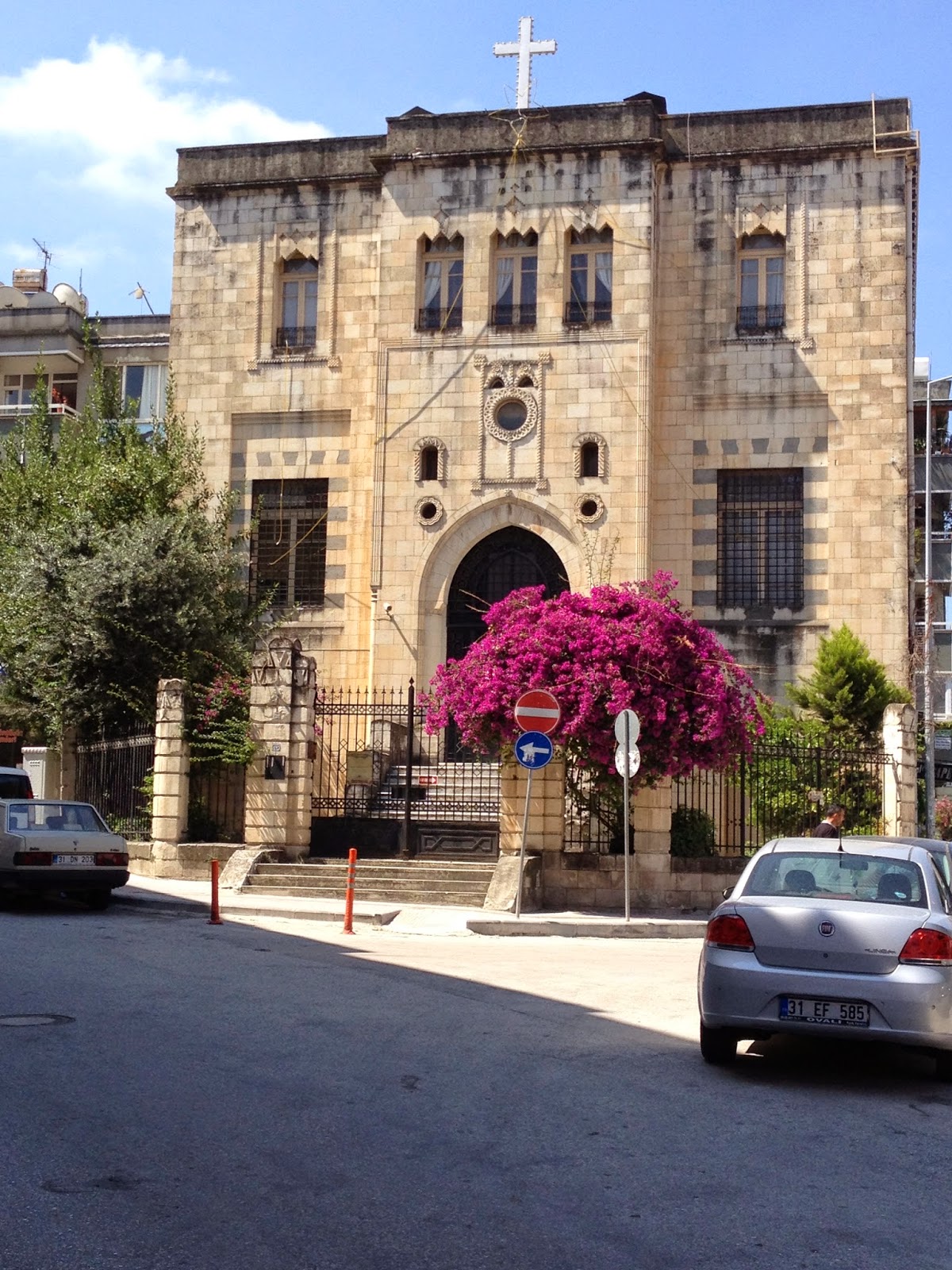
First stop, the Methodist Church of South Korea. We had already experienced that introducing yourself to someone here, introduces you to a history lesson. The Methodist Church of South Korea is housed in a former French government building. We read on a plaque that the key could be obtained from the Agape coffeehouse. We rounded the bend and found ourselves before a large glass, iron-framed door, painted Greek island blue.
            On the door a cardboard sign read: Little Korea. In English.
            We stepped in and looked about the large and empty space. A young man appeared. He looked at us cautiously. He wasn’t Korean. He could actually have been Greek and when he found out Th was, he said, kalimera. Th, guarded lest he be converted on the spot, smiled and continued the conversation in English.
            We soon learned that the church has 35 members. We already knew that the priest is from South Korean and that faithful will come all the way from South Korea for a Christmas pilgrimage. The 35 members from Antakya are shepherded by their Korean pastor. The Koreans chose Antakya because of its openness to Christians.
            “In other parts of Turkey,” the young man told us, “we meet in secret at one another's homes. We get persecuted.”
            “Like the first Christians?”
            After that, he smiled openly and started to tell us how he was part of the Good News. Meanwhile we had arrived in the hall of the church where about fifty chairs stood neatly arranged around an altar. On each side of the altar, a chair and against each chair an electrical guitar. 
            New ways for an old concept.
           
On our way to the Roman Catholic Church of Turkey, we walked by the tiny pink synagogue and the older brick building that also houses a synagogue. Neither were accessible. Then the old mosque, behind which the Catholic church. Antakya takes great pride that a mosque and a Christian Church stand shoulder to shoulder. Twice we went to that church. Once that Saturday, and once again on Sunday. At Mass time. But neither on Sunday could any amount of ringing on the attached doorbell get an answer. 


We even spoke to the woman who runs one of two adjacent souvenir stores that carry lots of
ecumenical trinkets. She couldn’t rouse the priest, either. We left, disappointed and hoping he was alright.
         

But never mind, we soon were trailing our way back to the centre through the ancient streets of Old Antakya. By the river, we found the museum, next to it a park. The museum is large enough but only a few halls were open. This meant that we got in for 3TL a piece instead of the usual 8TL. Three dollars for two tickets and a wealth of displays of Roman and Byzantine murals of the third to the fifth century after Jesus of Nazareth sent his apostles out. Once the Hilton is finished and more excavations will yield further riches, this museum will probably no longer be such a bargain.


After a light lunch, a nap, and then the künefe, only one bite for me because I was still being gentle with my stomach, we found Leila at the hotel lobby. She walked with us to the church, where she left us in the care of her sister. The Saint Paul church, which is called the Greek Orthodox Church of Antakya and All the Middle East, is one of the churches serving the barely more than 2000 Christian faithful of Antakya. It belongs to one of five patriarchates associated with the city. The patriarch of this church has his holy see in Syria. Again we were at one of the oldest Christian churches in the world except, because of earthquakes, this present building dates back to the nineteenth century. A tenacious community that will not let go of its religion, it mirrors the other minuscule Churches in the city, and minuscule here does not refer to the size of the buildings.
            We soon learned that when one of their own dies, the whole Christian community, regardless their Apostolic See, turns out. The building was full and the courtyard also. Against the fence the familiar standing sprays of flowers and ribbons. Leila’s sister steered us through the crowd and we found a place at the side where we got a good view of what was going on. The open casket in front, the priest and his acolytes uttering heart rending chants in Greek, Turkish, and Arabic, the women with their coiffed hair, some of it dyed, people coming and going, and the occasional cellphone going off, which was then answered. We could have been at any Greek Orthodox church.
            When the service was over, a woman took my hand in one of hers, ran the other one in a soft caress over my face and told me I was beautiful. Then she kissed me on both cheek.  Leila’s mother. From the sister we learned that the mother loved us the moment she saw a picture of us Leila showed her. We walked with our arms around one another toward the courtyard where tables and plastic lawn chairs were lined up for the faithful, and their guests.
            I travelled back in time and considered how those who came from far away and professed the same faith would have been welcomed. Not that our religious views were questioned but we had been identified as Greek Orthodox and Catholic. Lapsed or not never entered the conversation. And it wouldn't have mattered. We had come to the church. It was all that counted.
            Women with large trays full of cups of coffee and glasses of water were doing the rounds. Th and I sat back and surveyed the gathering. “This is what ecclesia means,” he said. “The gathering of community. Nothing more. Nothing less.”
            In a place where the number of Christians is dwindling, it is apparent that people have understood this very basic function of church, a place to stay connected. Here no swaggering priests trying to impress the gathering, here no notables holding sway over others. Here just people gathered to mourn the death of one of their dwindling numbers.

During the service many men and women quietly wiped away tears.
While power-hungry leaders fill the airwaves, the quiet continuation of people gathering seldom makes the headlines and yet it is this which sustains me and helps me survive. These kinds of gatherings quietly carve out a civilization that can withstand the onslaught of conflict and war. I looked at Th, who had struck up a conversation with an Aramaic Christian man. This man lived for forty years in Germany but wanted to grow old in his beloved Antakya.
            And who could blame him. Life is slow here, people take time for one another, the weather is pleasant, and the coffee is great. What more do you need?
            Soon, Leila’s mother took my hand again and kissed my cheek. She then led us to give our condolences to the grieving family. As I lined up with her to pay my respects to people I never met before, I knew I had become part of this wave of humanity.